

1. Scope and Rules Version
This guide teaches the currently public 2–4 player rules for Brass: Pittsburgh. New players can read in order while setting up the table. Players who already know another Brass game may start with “Three Relationships on the Map,” “Special Links and Crown Jewel Industries,” and “First-Game Reference.”
The game is still in production. Roxley’s download page labels the current file 2026-06-01, while the PDF footer reads Rulebook v2026.01. Roxley also describes it as a near-final draft: pink text is non-final, solo play remains in development, and translations will follow after the rules are finalized. The historical-figure page still contains placeholder copy as well. This guide covers only the published multiplayer procedure and does not invent biographies, solo rules, or missing rulings.
Rules references
- Roxley’s official product and download page;
- the current public English rulebook PDF;
- the rulebook release notice, which establishes the multiplayer scope and draft status.
If a later release changes card text, values, or timing, the newer official material controls.
2. Objective and Table Overview
The game lasts 2 eras, each with 8 rounds. The player with the most Victory Points after era 2 wins. Break ties by the higher position on the income track, then by money remaining.
The main scoring sources are:
- Victory Points on flipped industries at each era end;
- link points in locations adjacent to train links;
- cubes sold to markets when a resource industry is built;
- Quality Rewards and immediate effects on selected industries, pipelines, and Heavy Trains.
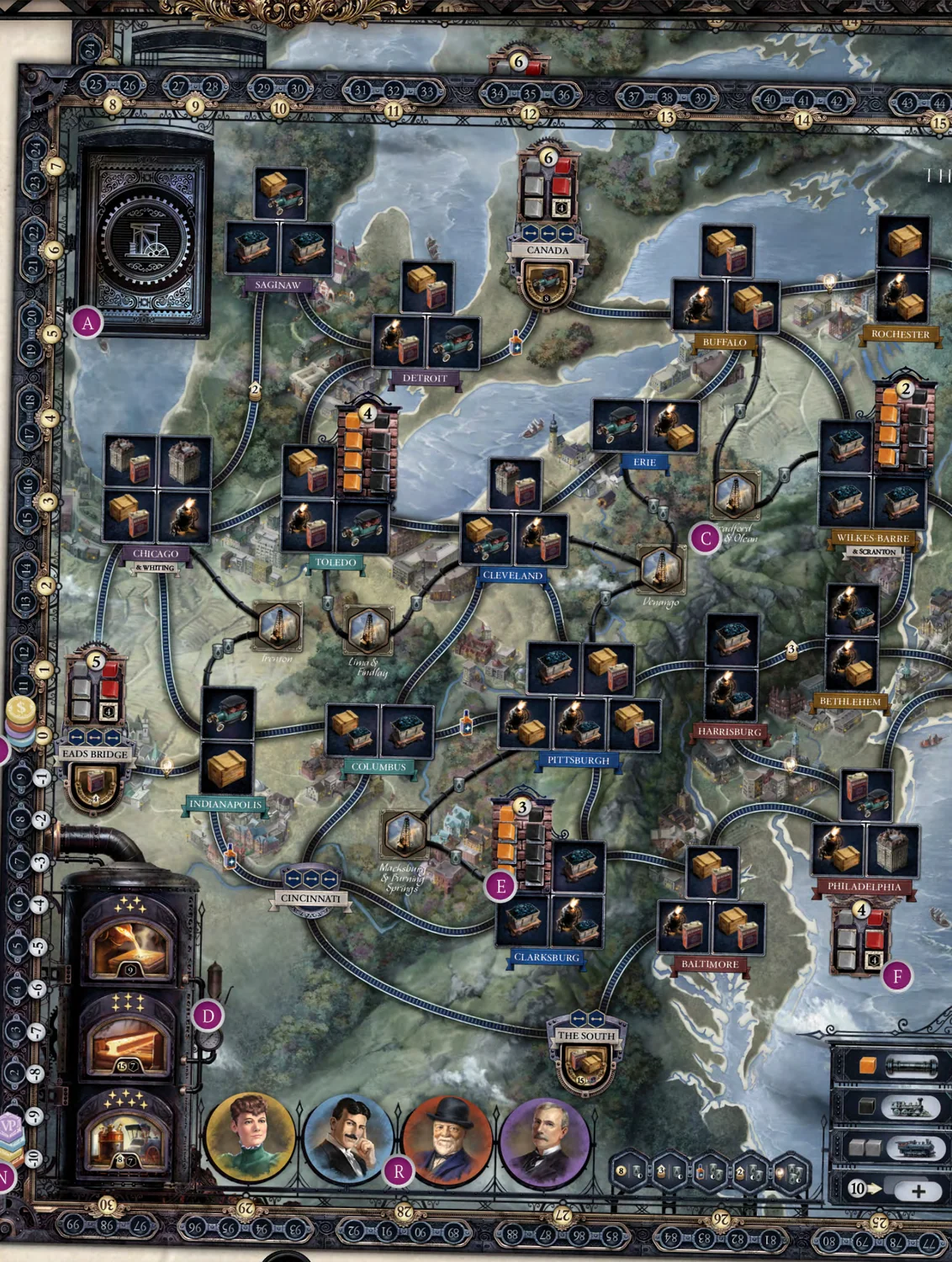
Figure: Board setup from page 4 of the official rulebook. Railroads run between cities, black routes connect oilfields, and resource markets sit around the inner and outer board. Current public rulebook, © Roxley Games; cropped and compressed only as needed for instruction.
Read the Board First
- City locations: Industry spaces show the industry types allowed there. A space displaying only one industry icon has placement priority for that type.
- Merchant locations: Merchant tiles around the board edge show which industries may sell there and a one-time reward.
- Railroad lines: Blue-gray routes between cities and merchants. Both Light Trains and Heavy Trains occupy them.
- Pipeline routes: Black routes from oilfields to cities. Pipelines are the first step that lets oil leave an oilfield.
- Resource markets: Three Coal/Iron markets sit inside the map; three Steel/Coke markets sit around its perimeter.
- Vanderbilt: The board’s fallback supplier. When no suitable industry is available and you do not use a market, he can deliver a resource anywhere at the high printed price.
- Progress track: Tracks both VP and income position. The coin beneath the income marker’s space shows the current income level.
Then Read the Player Mat and Industry Tiles
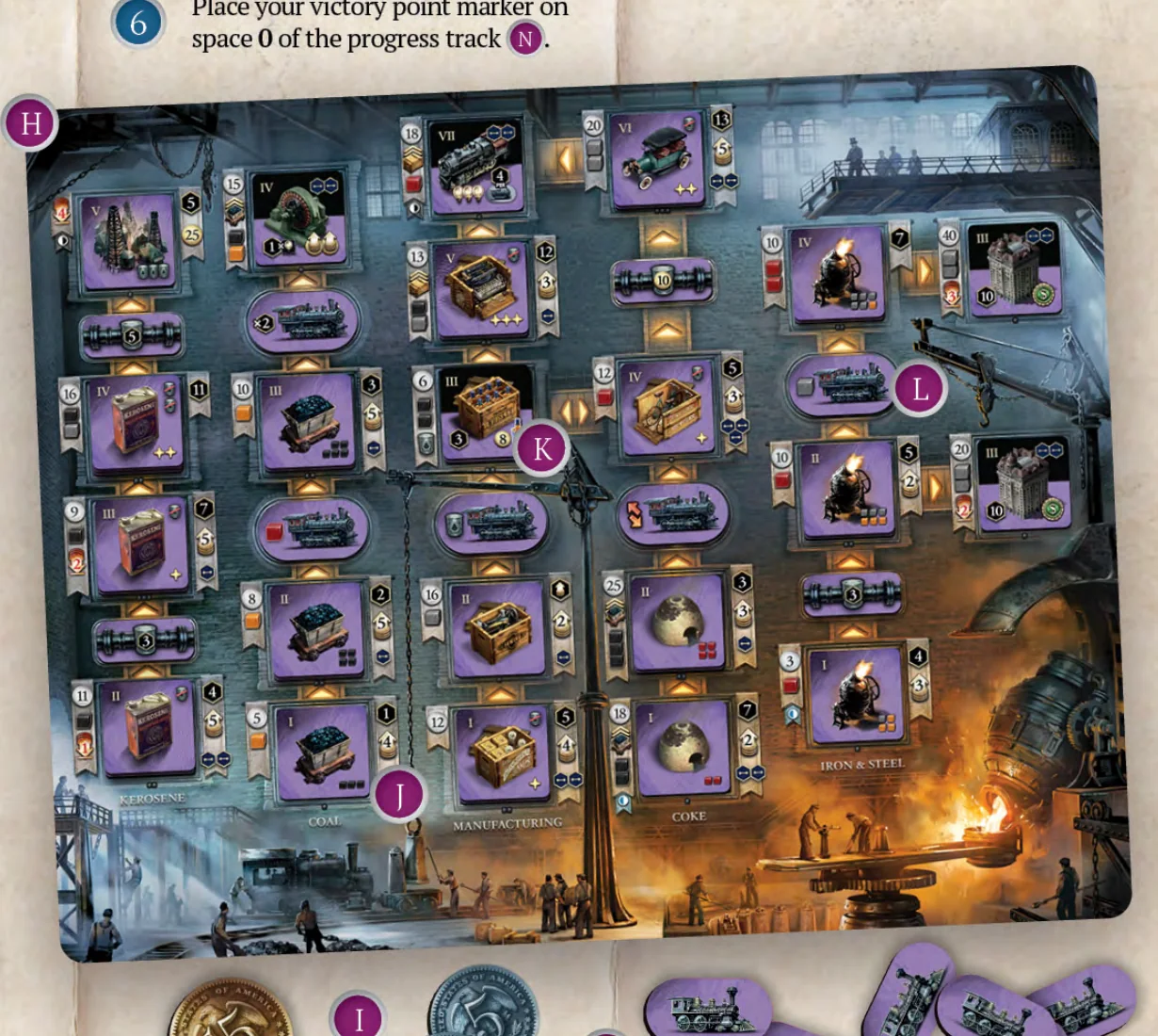
Figure: Player-mat example from page 5 of the official rulebook. Arrows define accessible industry progression, while adjacent industries unlock pipelines and Heavy Trains. Current public rulebook, © Roxley Games; cropped and compressed only as needed for instruction.
Each mat has five industry paths: Kerosene, Coal, Manufacturing, Coke, and Iron & Steel. The Steel path branches toward Skyscrapers, while Coke and Manufacturing have shortcut branches. An accessible tile is available to build or develop: it is the bottom tile in its path, or the next tile reached by following the arrows past a cleared position.
Every industry tile has one of two states:
- Unflipped: Newly built, still holding resources or awaiting sale;
- Flipped: Production or sale is complete, immediate rewards have been taken, and its lower-left VP will score at era end.
Common tile areas are:
- left side: build costs, which may include money, resources, and income adjustments;
- upper right: oil required to sell;
- right-side stars: Quality Stars;
- lower right: immediate rewards gained on flipping;
- lower-left black hex: Victory Points at era end;
- top blue link icons: link points used by adjacent train scoring.
Further Context — Flipping Marks the End of an Industry Chain
Resource industries usually flip when their final cube is removed. Kerosene, Manufactured Goods, and Automobiles flip through a Sell action. A few late industries enter play already flipped. Identify the family first, then find its flip timing.
3. Three-Player Setup
Shared Area
- Use the 3–4 player side of the board. Before shuffling, keep only Location and Industry cards with a 3-player icon at bottom right.
- Place one random Merchant tile gold-side up at each merchant location.
- Shuffle the oilfield tiles used for this player count and place one facedown on every oilfield space.
- Shuffle the 6 Quality Reward tiles, reveal 3 at the lower left of the board, and return the rest to the box.
- Fill all three Coal/Iron markets and all three Steel markets. Put only 1 Coke cube in the top space of each Coke market.
- Put money, Whiskey, oil barrels, Coal, Iron, Steel, and Coke within reach. The general supply is unlimited; use substitutes if components run short.
Player Areas and First-Round Order
Each player:
- Chooses one side of a Character tile and takes the matching player mat and all industry tiles of that color.
- Stacks industries on matching mat spaces, solid-color side up. Tiles without a solid-color side are simply placed in position.
- Fills the printed Pipeline and Heavy Train spaces on the mat with matching link tiles, then puts the remaining 2 Heavy Trains, 2 Pipelines, and 9 Light Trains in a personal supply.
- Takes $30, places the VP marker on 0, and puts the income marker on progress space 10, which is income level 0.
- Draws 8 cards. During era 1 setup only, draw 1 additional card and place it facedown in the discard pile.
After everyone is ready, shuffle the Character tiles and place them randomly on the turn-order track. This is the order for round 1.
Other Player Counts
| Players | Board | Deck filter | Additional change |
|---|---|---|---|
| 2 | 2-player side | Keep only cards with a 2-player icon | Remove the oilfield that produces 3 oil and the merchant that rewards $15 |
| 3 | 3–4 player side | Keep only cards with a 3-player icon | None |
| 4 | 3–4 player side | Keep only cards with a 4-player icon | None |
The oilfield tiles used on each board side are also pictured along the bottom of that side.
4. Eras, Rounds, and Player Turns
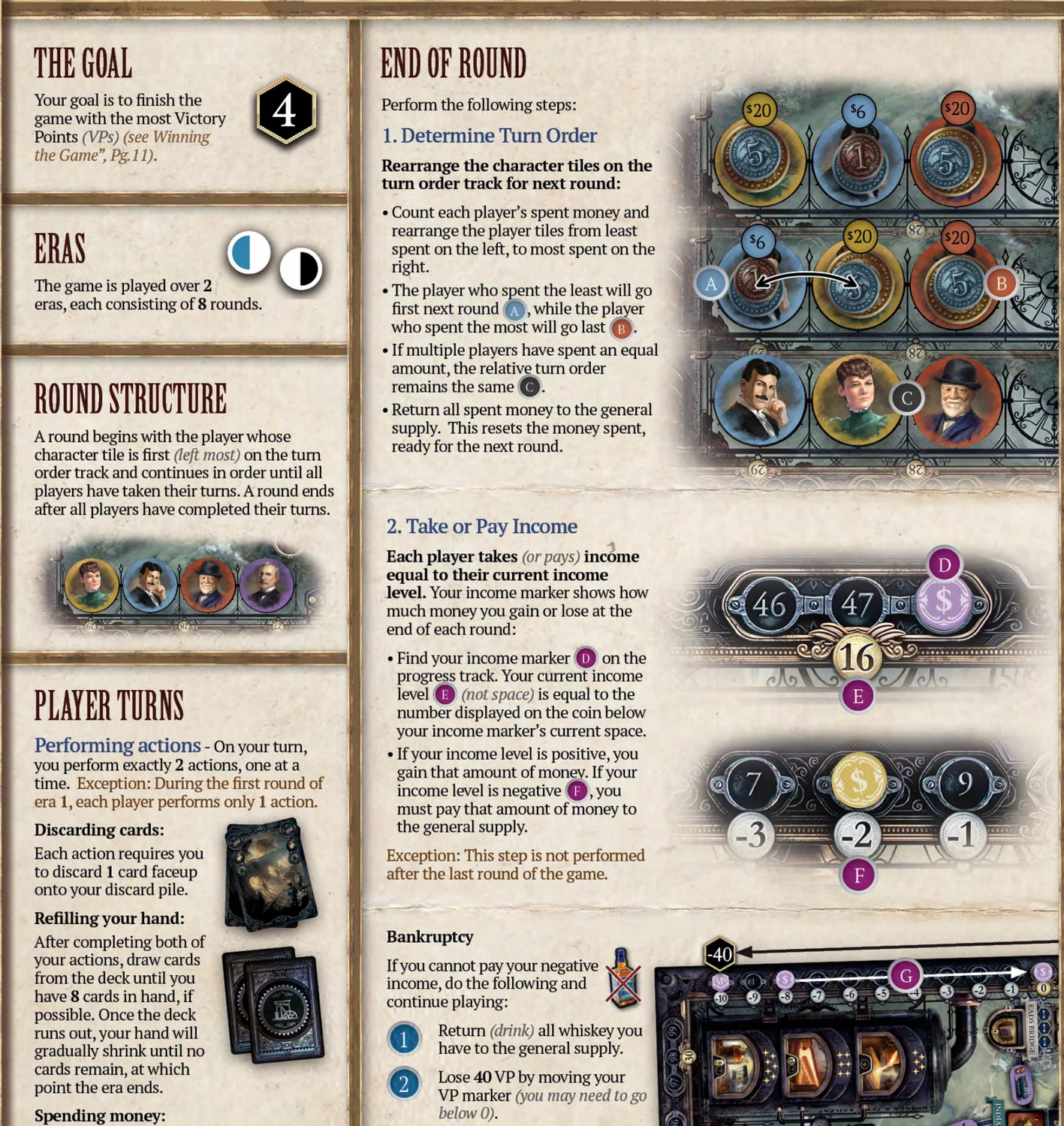
Figure: Flow summary from page 6 of the official rulebook. The player who spends less acts earlier next round, and income uses the coin value beneath the marker’s current position. Current public rulebook, © Roxley Games; cropped and compressed only as needed for instruction.
One Player Turn
A normal turn proceeds as follows:
- Choose and complete action 1, discarding 1 card faceup.
- Choose and complete action 2, discarding another card faceup. The two actions may be identical.
- After both actions, draw back to 8 cards if possible. Once the deck is empty, hands shrink from round to round.
The only round exception is round 1 of era 1: each player takes only 1 action, then refills.
The six actions are:
| Action | Main result | Card requirement |
|---|---|---|
| Build | Place 1 industry from the player mat on the board | Location card, Industry card, or any card plus 1 Whiskey |
| Network | Place 1 link; optionally pay another $10 to place a second | Any card |
| Develop | Permanently remove 1–2 accessible industries from the mat | Any card |
| Sell | Sell one or more eligible industries together | Any card |
| Loan | Gain $30 and reduce income by 3 levels | Any card |
| Pass | Gain 1 Whiskey | Any card |
Pass is still an action, so it also discards a card. The bonus Sell action from a Skyscraper is an explicit exception and discards no card.
End of a Round
After every player finishes:
- Compare the money placed on Character tiles this round. The lowest spender moves to the leftmost position for next round, and the highest to the rightmost. Ties preserve relative order.
- Return that spent money to the general supply.
- Each player takes money equal to their current income level, or pays the supply if it is negative. Skip this income step after the final round of the whole game.
All money paid during a turn, including market purchases, Vanderbilt delivery, and the $10 for a second link, goes on the Character tile for turn-order comparison.
Unable to Pay Negative Income
If a player cannot pay negative income, they continue playing but must:
- return all Whiskey they hold;
- lose 40 VP, even if this moves below 0;
- return the income marker to income level 0, progress space 10.
5. Three Relationships on the Map
Your Network
A “location” is a city or merchant space with at least one railroad line connected to it. Oilfields are not locations.
A location is part of your network if either condition is true:
- it contains one or more of your industry tiles;
- it is adjacent to one or more of your link tiles.
Industry-card Builds and later Network expansion check your network. A Location card bypasses this restriction and builds directly in its named location.
Connected Locations
Two locations are connected when a continuous railroad route joins them. The route may mix any players’ Light and Heavy Trains. Pipelines never connect two locations.
“In your network” and “able to transport” are therefore separate checks. The former looks for your own industries and links; the latter looks for a continuous railroad made from everyone’s trains.
Further Context — Infrastructure Is Shared, Ownership Is Not
Opponents’ railroads may carry your resources, and their unflipped resource industries may become your mandatory source. Railroad scoring, industry flip rewards, and income still belong to the component owner. This shared dependency drives the table interaction.
Resource Transport and Source Priority
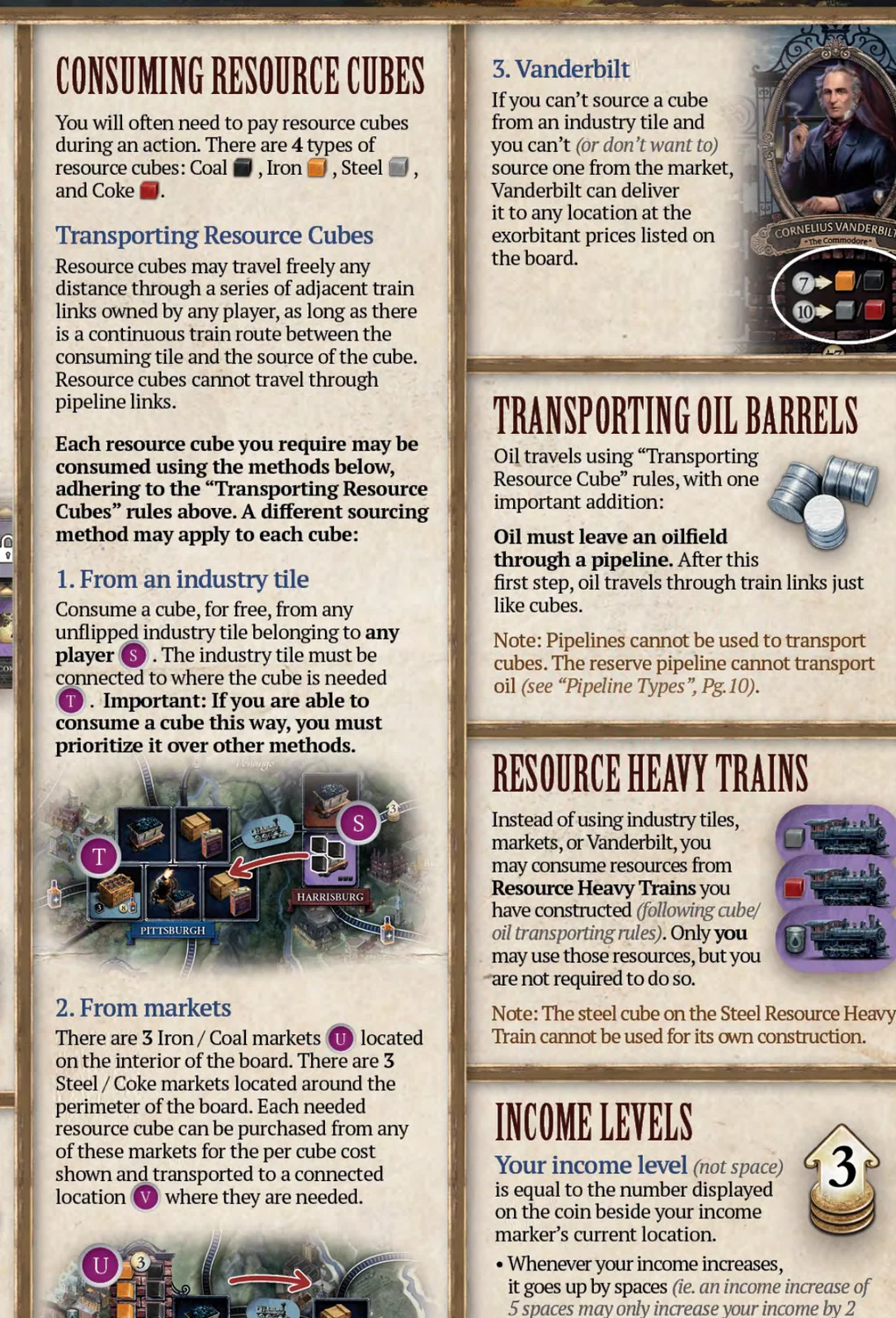
Figure: Resource transport from page 7 of the official rulebook. Industry resources have mandatory priority, and pipelines cannot carry resource cubes. Current public rulebook, © Roxley Games; cropped and compressed only as needed for instruction.
Coal, Iron, Steel, and Coke may travel any distance along a continuous railroad. Check a source separately for each cube required:
- Check connected unflipped industries first. If any player’s industry has the required cube, you must take one from an eligible tile for free. You cannot choose a market or Vanderbilt instead.
- If no industry can supply it, buy from a connected market at the printed price, use your own connected Resource Heavy Train, or pay Vanderbilt’s price for delivery to any location.
Different cubes in one cost may use different sources. When the last cube leaves an industry, flip it immediately and give its owner the lower-right reward.
Oil adds one restriction: oil taken from an oilfield must first leave through a Pipeline that can transport oil, then follow continuous railroads to its destination. Whenever oil uses a Pipeline, that Pipeline’s owner immediately gains its type of reward. A Reserve Pipeline cannot carry oil. Oil already stored on your own Resource Heavy Train instead follows that train’s exception and travels by rail to where you use it.
6. Build Action
Choose a Card and Location
First determine what the discarded card permits:
- Location card: Build any allowed industry in that location, even outside your network;
- Industry card: Build the matching industry in a location in your network. If you have no industries or links anywhere on the board, it may build in any allowed location;
- Any card plus 1 Whiskey: Treat that card as any Location or Industry card.
Then choose 1 accessible tile from the matching path. When placing it:
- If the location has an empty space showing only that industry icon, you must use that space first. Otherwise use a multi-industry space.
- In era 1, each player may have at most 1 industry in a location. Era 2 removes this restriction.
- Industries marked with an era-1 half-circle build only in era 1; full-circle industries build only in era 2.
Pay and Upgrade
Pay money, resources, and income adjustments shown along the tile’s left side in any order. Required resources follow the transport and source priority above.
A tile with an upgrade icon in its cost can be built only by upgrading:
- the replaced industry must be yours;
- it must already be flipped;
- remove it immediately and score its VP;
- place the new industry in that same space, never an empty one.
Place Resources and Sell Automatically to Markets
After building, place the resource cubes or oil barrels shown at lower right. If a Coal, Iron, Steel, or Coke industry is connected to matching markets with empty slots, its resources sell automatically at that moment:
- Move as many resources as possible into one or more connected markets, in an order chosen by the builder.
- For each cube, gain the money beside the market and any VP printed in the slot filled.
- If the final resource leaves, flip the industry and take its reward. Resources that cannot enter a market remain on the tile.
This automatic market sale occurs only when the industry is built. Resources do not move later merely because market space opens.
A few industries are already flipped when built. Resolve their lower-right rewards immediately, but leave their lower-left VP until era end unless an upgrade later removes them.
7. Network Action
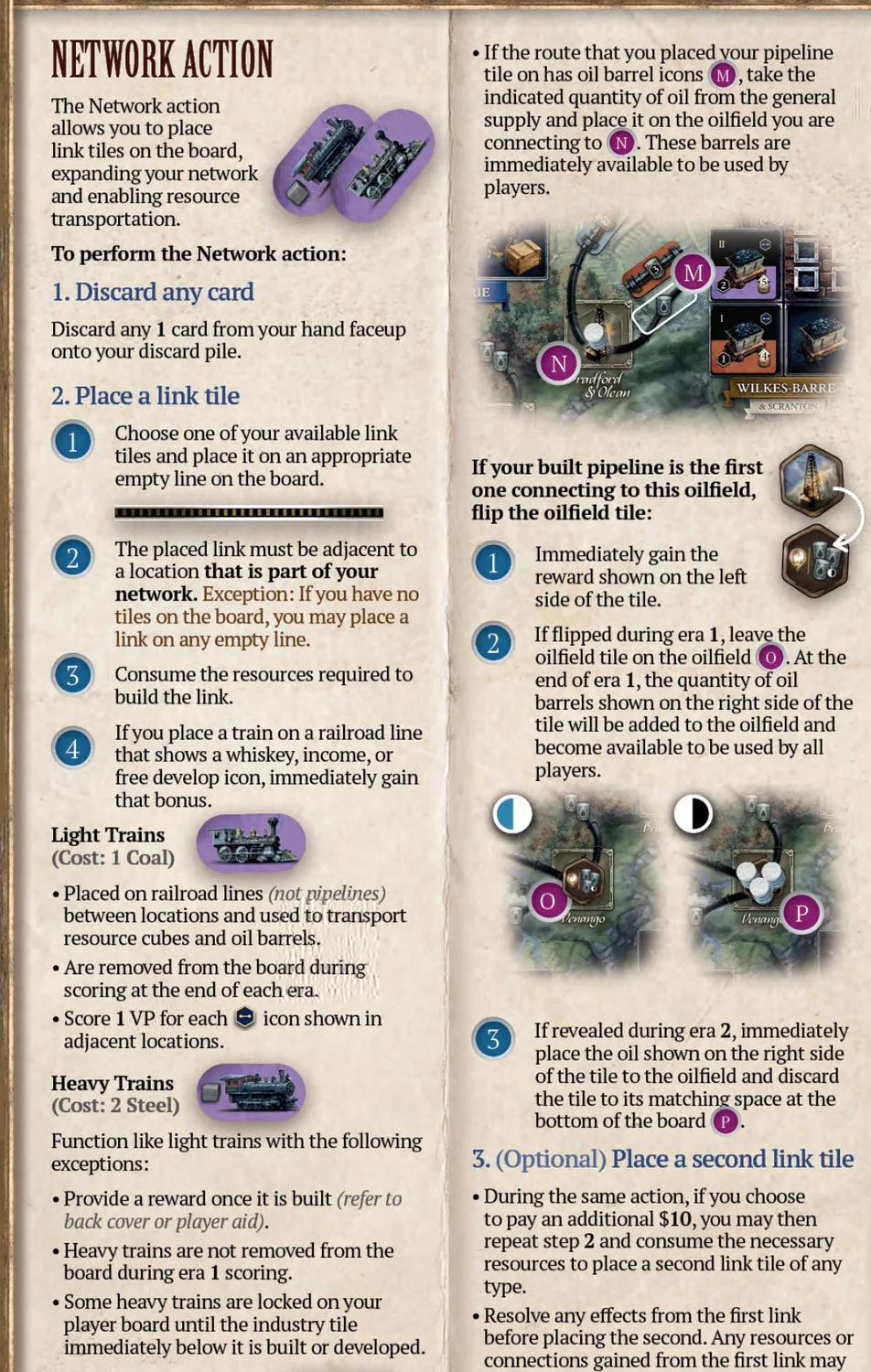
Figure: Network action and oilfield examples from page 9 of the official rulebook. The first link may provide a route or resource for the second link in that same action. Current public rulebook, © Roxley Games; cropped and compressed only as needed for instruction.
To take a Network action:
- Discard any 1 card.
- Choose an unlocked link from your supply and place it on a matching empty route.
- The new link must be adjacent to a location in your network. If you have no components on the board, it may occupy any valid empty route.
- Pay the resource cost. If a train covers a Whiskey, income, or free Develop icon, gain that bonus immediately.
The three basic link classes are:
| Link | Base cost | Use and era handling |
|---|---|---|
| Light Train | 1 Coal | Carries cubes and oil; scores and is removed at each era end |
| Heavy Train | 2 Steel | Also carries resources; has a build reward and remains after era 1 |
| Pipeline | 1 Iron | Connects a city to an oilfield; carries no cubes and never scores as a railroad |
After fully resolving the first link, you may pay an additional $10 and place a second link of any type in the same action, paying its resource cost as normal. The first link’s new route, generated resources, and rewards may help place the second. Do not discard another card for it.
Pipelines and Oilfields
- If the Pipeline route shows oil-barrel icons, add that much oil to its oilfield immediately.
- When the first Pipeline connects to an oilfield, reveal its oilfield tile and gain the left-side reward.
- If revealed during era 1, leave the tile there and add its right-side oil production at the end of era 1.
- If revealed during era 2, add the right-side oil immediately, then move the tile to its matching space along the bottom of the board.
8. Develop, Loan, and Pass
Develop
- Discard any 1 card.
- Permanently remove 1 or 2 accessible industries from your player mat. They may come from different paths.
- Pay 1 Iron or 1 Steel per tile removed. Use normal source priority; if no source is connected, Vanderbilt can deliver at the printed price.
Developed tiles never return. Developing skips lower industries and may unlock Pipelines or Heavy Trains between them. As soon as a link becomes accessible, move it into your personal supply.
Loan
- Discard any 1 card.
- Take $30.
- Reduce income by 3 levels, placing the marker on the highest space of the new level.
Loans are never repaid. You cannot take one if it would reduce income below −10. Income increases normally move by spaces, while income reductions move by levels; keep the two units separate.
Pass and Whiskey
Discard any 1 card and gain 1 Whiskey. A player can hold at most 3; ignore any excess. Whiskey has two uses:
- turn any card into any Location or Industry card during Build;
- spend 1 during Sell to add 1 Quality Star toward that action’s Quality Reward.
9. Sell Action
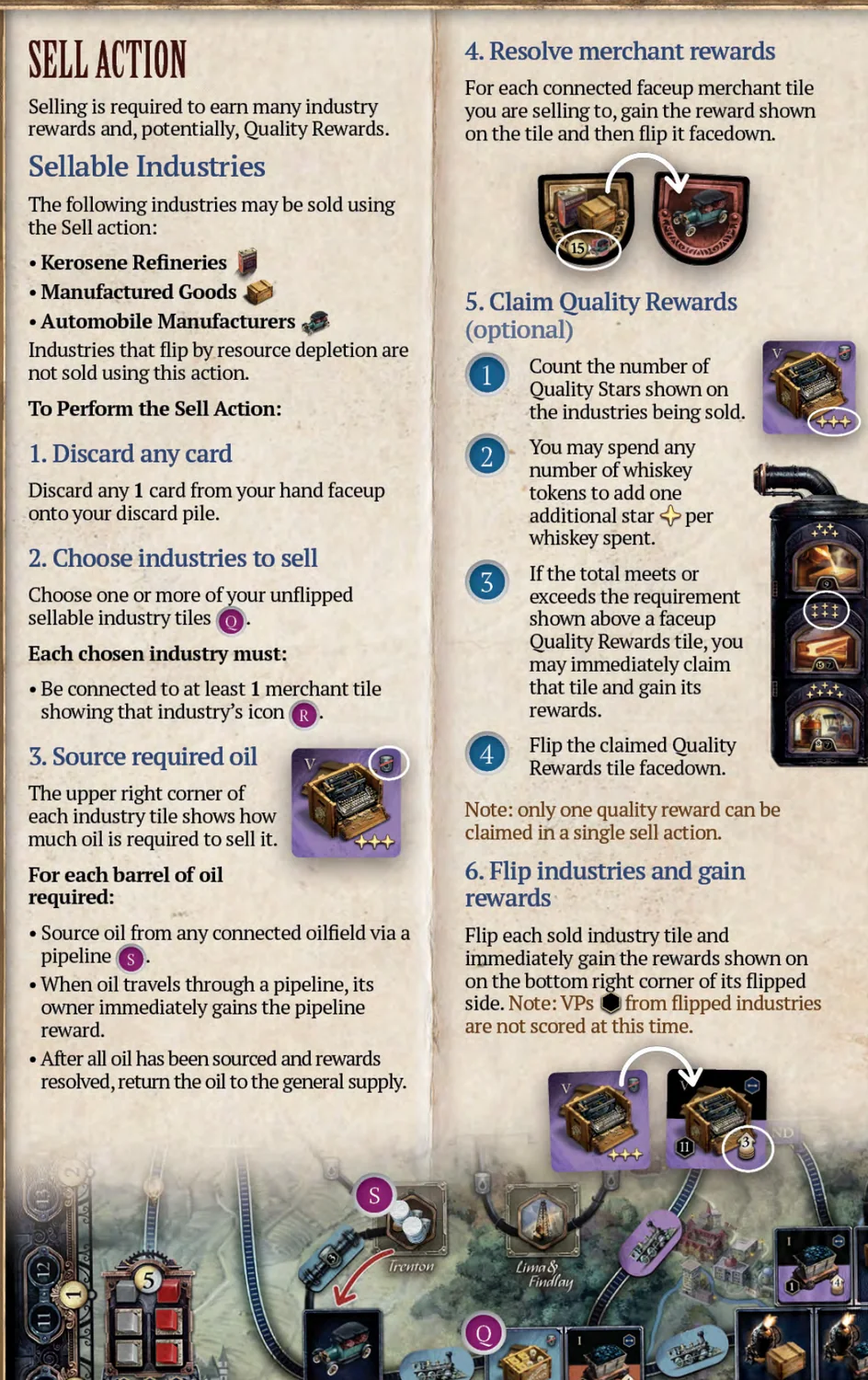
Figure: Sell procedure from page 9 of the official rulebook. Quality Stars may be totaled across all industries in this sale, but each Sell action claims at most 1 Quality Reward. Current public rulebook, © Roxley Games; cropped and compressed only as needed for instruction.
Sell handles only three kinds of unflipped industry:
- Kerosene Refineries;
- Manufactured Goods;
- Automobile Manufacturers.
Resolve these steps in order:
- Discard any 1 card.
- Choose one or more of your unflipped sellable industries. Each must connect to a faceup Merchant showing that industry icon.
- Supply the oil shown at upper right on each industry. Oil taken directly from an oilfield must first use a Pipeline. For every barrel passing through it, the Pipeline’s owner gains the printed reward. Return the used oil to the general supply after all rewards resolve.
- For every faceup Merchant used in this sale, gain its reward and flip it facedown.
- Optionally resolve 1 Quality Reward. Total the Quality Stars on all industries sold, then spend any number of Whiskey for 1 additional star each. If the total meets or exceeds a faceup reward’s requirement, claim the tile and its reward, then flip it facedown. One Sell action claims at most 1.
- Flip every sold industry and gain its lower-right reward immediately. Leave lower-left VP for era end.
Coal, Iron, Steel, and Coke industries flip by depletion and never use the Sell action.
Further Context — One Sale Requires Three Independent Chains
Rail from industry to Merchant establishes eligibility. “Pipeline plus rail” from oilfield to industry supplies oil. Quality Stars count only the industries selected in this action. Check each chain separately; success in one does not repair another.
10. Special Links and Crown Jewel Industries
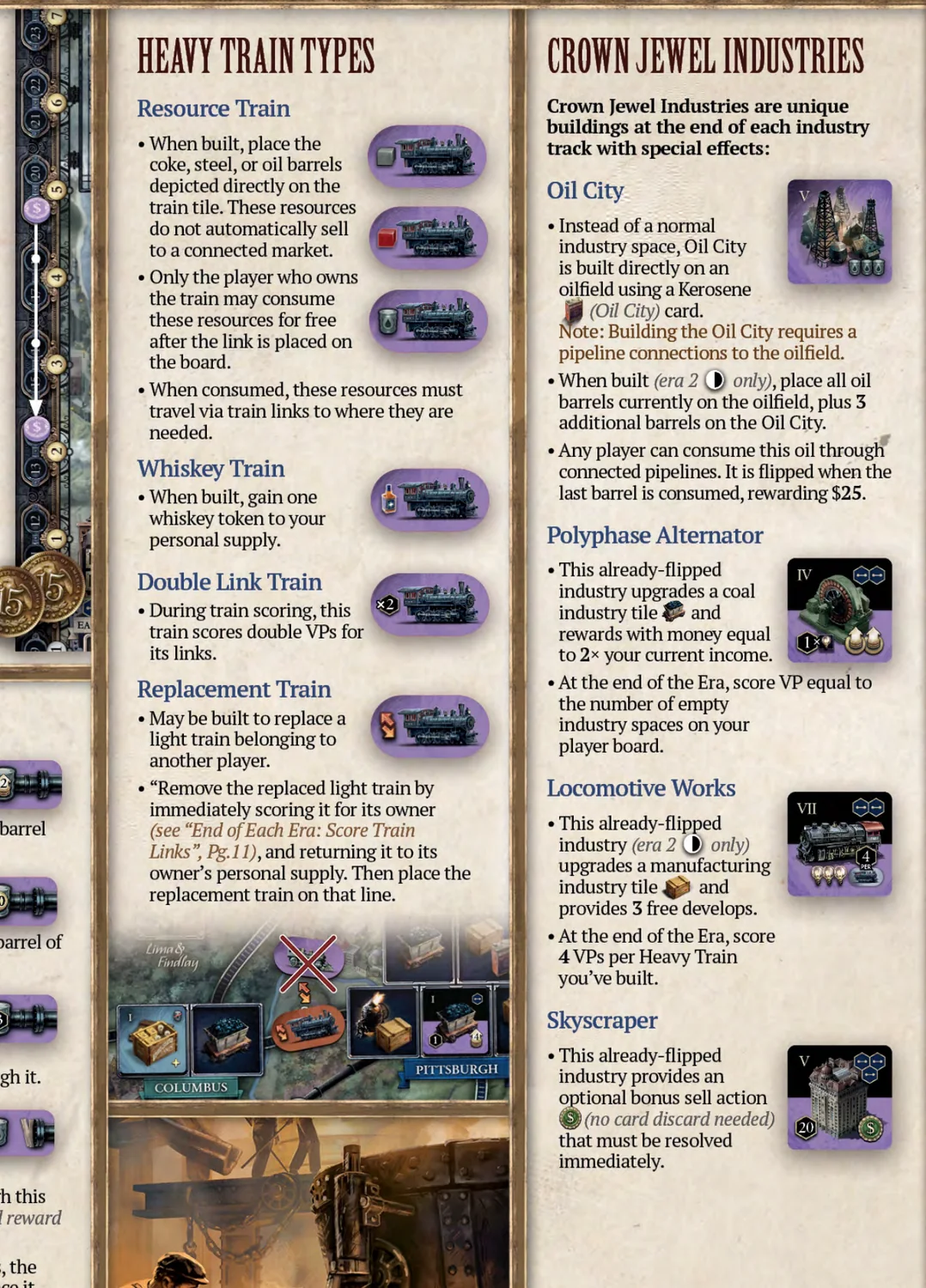
Figure: Heavy Trains and Crown Jewel Industries from page 10 of the official rulebook. These components modify ordinary Build, transport, or era-scoring rules. Current public rulebook, © Roxley Games; cropped and compressed only as needed for instruction.
Four Heavy Train Types
- Resource: Place the pictured Coke, Steel, or oil on it when built. These resources do not sell automatically; only the owner may consume them for free, and they still travel by rail. Steel on the Steel Resource Train cannot pay for that train’s own construction.
- Whiskey: Gain 1 Whiskey when built.
- Double Link: Double this train’s link-point VP at era scoring.
- Replacement: May replace an opponent’s Light Train. First score the displaced train immediately for its owner and return it to that owner’s supply, then place the Replacement Train.
Four Pipeline Types
- Income Pipeline: Its owner gains the printed income for every oil barrel passing through;
- Money Pipeline: Its owner gains the printed money per barrel;
- VP Pipeline: Its owner gains the printed VP per barrel;
- Reserve Pipeline: Adds 1 oil to the connected oilfield when built, but no player may transport oil through it. When its owner later places a Pipeline, they may replace the Reserve Pipeline with another Pipeline from their supply and return the Reserve to supply.
Four Crown Jewel Industries
- Oil City: In era 2, use the specified Kerosene card to build directly on an oilfield that already has a Pipeline connection. Move all oil there plus 3 additional barrels onto Oil City. Any player may consume it through connected Pipelines. Flip it when the last barrel leaves and gain $25.
- Polyphase Alternator: Upgrade a Coal industry; it enters flipped and immediately gains money equal to twice current income. At era end, score VP equal to empty industry spaces on the player mat.
- Locomotive Works: In era 2, upgrade a Manufacturing industry; it enters flipped and grants 3 free Develops. At era end, score 4 VP per Heavy Train you built.
- Skyscraper: Enters flipped and grants an optional bonus Sell action. It discards no card and, if used, must resolve immediately.
Crown Jewel Industries still follow the normal upgrade conditions: the replaced industry must be yours and already flipped.
11. A Complete Three-Player First Round
This example avoids fixed printed prices and demonstrates only legal order and rule connections. Assume players A, B, and C act in that order.
- A builds Coal. A discards a Pittsburgh Location card, places the current accessible Coal tile in Pittsburgh’s Coal space, pays the costs at left, and adds Coal cubes. Owning that industry makes Pittsburgh part of A’s network. If no Coal market is connected, the cubes stay on the tile.
- B places a Light Train. B has no component on the board, so the first railroad may occupy any empty line. B chooses one adjacent to Pittsburgh. After placement it costs 1 Coal. A’s connected unflipped Coal industry can supply it, so B must take 1 there for free instead of buying from Vanderbilt.
- C takes a Loan. C discards any card, gains $30, and moves income down 3 levels. The Loan itself spends no money, so C’s Character tile still shows $0 spent.
Round 1 of era 1 gives each player only that single action, after which everyone refills to 8 cards. At round end, C’s $0 moves to the front of next round. A and B sort by their actual spending, preserving order if tied. Everyone then takes or pays current income.
The round has already created three future lines: A may let opponents deplete and flip the Coal industry; B now has a network for Industry-card Builds; C traded long-term income for cash and earlier turn order.
12. Era End and Scoring
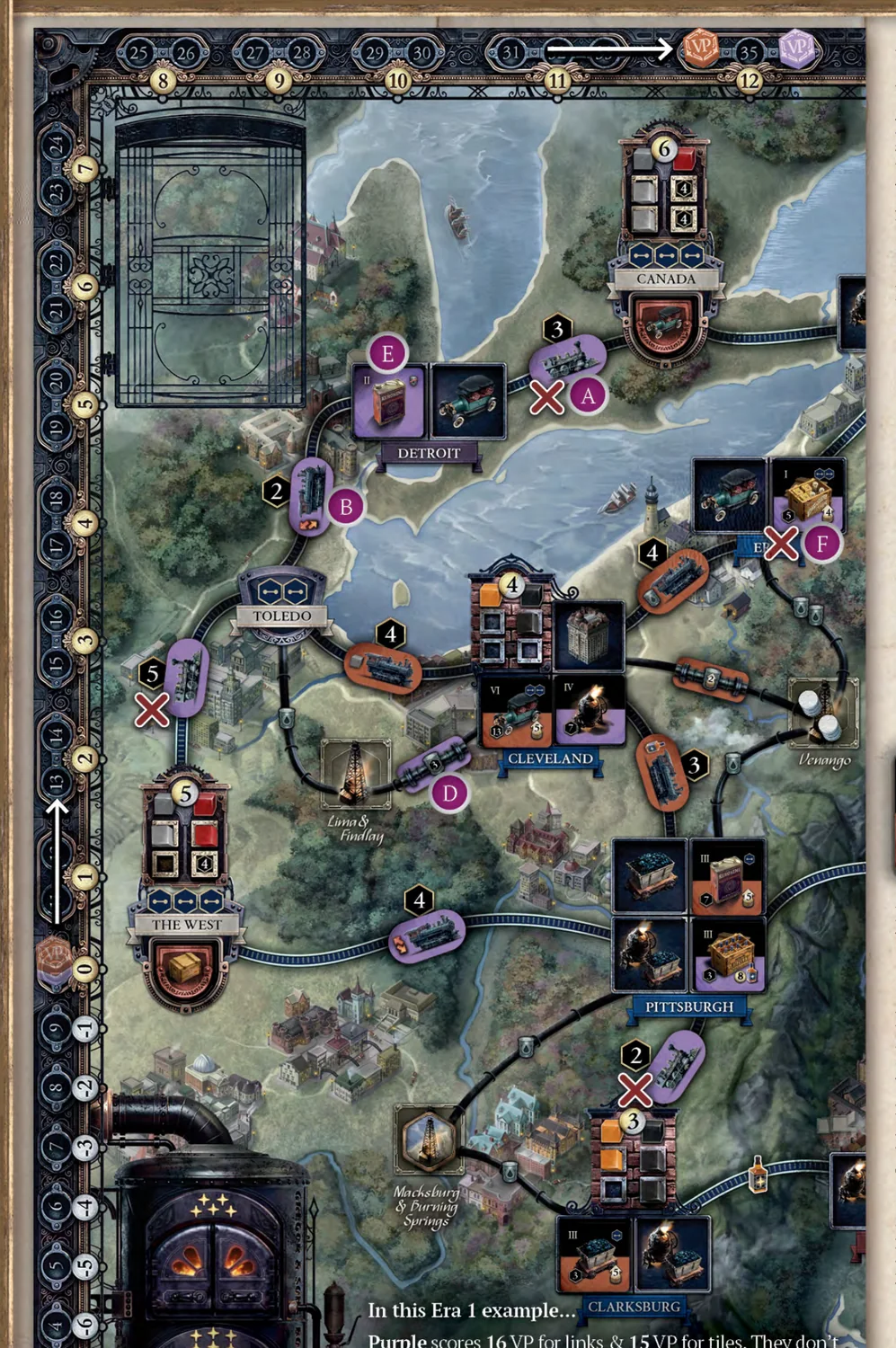
Figure: Era-1 scoring example from page 11 of the official rulebook. Light Trains leave after scoring, while Heavy Trains and Pipelines remain; unflipped industries do not score. Current public rulebook, © Roxley Games; cropped and compressed only as needed for instruction.
An era ends after the round in which every player uses their final cards. First resolve normal end-of-round turn order and income; only the final round of the whole game skips income. Then follow the era procedure.
At the End of Each Era
- Score train links: For each of your Light and Heavy Trains, score 1 VP for every link-point icon in its two adjacent locations. A Double Link Heavy Train applies its exception.
- Remove trains: After era 1, remove scored Light Trains but leave Heavy Trains. After era 2, remove every train. Pipelines always remain and never score railroad links.
- Score industries: Score the lower-left VP on every flipped industry. Unflipped industries score nothing.
Additional Steps After Era 1
- Remove every level-1 industry from the board, flipped or unflipped.
- Move oil waiting beneath each oilfield tile onto that oilfield.
- Collect all discard piles. Turn over the bottom card in each pile so every card faces the same direction, shuffle them into the era-2 deck, and deal 8 cards to each player.
Industries above level 1 and Heavy Trains that were not removed remain on the board. If they still qualify, they score again at the end of era 2.
After the same railroad and industry scoring in era 2, the most VP wins. Break ties by higher income-track position, then by most money.
Further Context — Era Transition Preserves Long-Term Capital
Era 1 removes Light Trains and level-1 industries, while Heavy Trains, Pipelines, and higher industries persist. Early investment should weigh immediate scoring, era-2 reuse, and removal risk together.
13. First-Game Reference
Turn Check
- Is this round 1 of era 1? Take only 1 action; otherwise take 2.
- Did every action discard 1 card? For Build, did the card match its location or industry?
- Is all money spent sitting on the Character tile?
- Did the player refill to 8 cards after the turn?
- At round end, did turn order change before income resolved?
Action Check
- Build: Accessible tile, legal space, era icon, network permission, costs, resource placement, automatic market sale;
- Network: Link unlocked, correct route type, adjacent to your network, resources paid, route bonus resolved;
- Develop: Remove only accessible tiles and pay 1 Iron or Steel per tile;
- Sell: Industry eligible, Merchant icon matches, oil route exists, Merchant and Quality Reward flip, industries flip last;
- Loan: Income falls 3 levels and does not go below −10;
- Pass: Discard 1 card and keep Whiskey at 3 or fewer.
Common Misreads
- Your network uses only your components; resource transport may use any player’s continuous railroad.
- If a connected industry provides a required cube, you must consume industry supply first.
- Pipelines cannot transport Coal, Iron, Steel, or Coke. Oil leaving an oilfield must use a Pipeline first.
- Automatic sale to a market occurs once, when the resource industry is built. Later vacancies do not move resources automatically.
- Sell flips industries and gives immediate rewards, but industry VP waits for era scoring.
- A second link belongs to the same Network action: pay another $10 and its resources, but discard no additional card.
- Income increases move by spaces; Loans and other income reductions move by levels.
- Era 1 removes Light Trains and all level-1 industries. Heavy Trains, Pipelines, and higher industries remain.
- The current public rules draft may still change. If a newer rulebook, card, or official clarification conflicts, use the newer material.
Comments
Comments are public and stored in GitHub Discussions. This page connects to giscus.app and GitHub and sends the current page path only after you show comments manually or enable automatic loading. The first load is about 0.13 MB; actual usage varies with comment content. Do not include private information.