

Watch the film first: what happens in 5:49
At 17:37:40 on August 23, 2026, the complete adaptation went public on Bilibili. The page title is 顶级AI零成本制作 | 经典课文《荷塘月色》配图朗读, the displayed duration is 05:49, and the page labels the video as containing AI-generated content. The reading runs from the opening admission of restlessness all the way to the narrator’s return through the door. Its images form one continuous night walk: a thought begins indoors; the narrator crosses the road outside the wall and follows a coal-dust path to the pond; he lingers among moonlight, tree shadows, and sounds at different distances; Jiangnan lotus-picking enters his imagination; and the path finally ends at home.
Watch the public film on Bilibili: 顶级AI零成本制作 | 经典课文《荷塘月色》配图朗读
This essay asks what viewers see, hear, and understand in the finished film. It also asks about the particular person behind the landscape: how he feels about the life before him, and what he desires during this night. The textual responsibility table, real narration timing, keyframes, sound, deterministic assembly, and validation methods are developed separately in the companion essay on the reusable production workflow.
Giving the landscape’s subject back to “I”
Moonlight over the Lotus Pond leaves us many visible objects to verify: lotus flowers, leaves, the moon, willows, and water. Yet the subject of every view remains “I.” The narrator passes this pond every day, but tonight he feels that it must look different. On a moonless night the path is gloomy and frightening, but tonight it feels good. A full moon fails to shine brilliantly, and he decides that this dimness is exactly right. The landscape changes first because a restless person is choosing how to see it.
The essay is therefore more than an observation of a moonlit scene. Zhu Ziqing brings the dark path, pale moon, lotus fragrance, cicadas and frogs, and old poetry into a movement of the mind. Through sensation and imagination, he briefly remakes the life in front of him. That is the movement the film must carry: ordinary pressure recedes, solitude opens into freedom, beauty consoles, and consolation reveals its limits.
Restlessness is the essay’s present tense
“These days my heart has been rather restless” does not name one cause. The political rupture of 1927, duties at Tsinghua, workplace affairs, finances, and family burdens can all provide context, but none can establish a single answer for the sentence. The prose gives us more intimate evidence: in daylight there are things one “must do” and words one “must say.” This restlessness belongs to the life an adult actually carries, with its tasks, social obligations, and roles that have to be performed.
He quietly puts on a long gown and closes the door behind him. Reality has not been renounced; he has only stepped out of its soundscape for a while. The children’s laughter has faded, his wife is patting Run’er and humming him to sleep, and home remains behind him. The walk becomes a restrained act of self-regulation: unable to settle within life as it currently feels, he goes out and claims a stretch of time in which no one is urging him onward.
“A free man”: what he actually desires
The most immediate desire in the walk is stated plainly: he may think about anything, or think about nothing at all. Freedom here is no grand slogan. It is temporary authority over his own attention—the release from finishing a task, answering another person, or saying the words that daylight requires.
“I love liveliness, and I also love calm; I love company, and I also love solitude” is crucial. Zhu does not cast himself as innately solitary, nor does he turn family and society into enemies. The same person needs connection and withdrawal. A life worth desiring would leave room for both: a person could enter company and still have a way back to the self.
The small word qie—“for now”—in his decision to enjoy the boundless lotus fragrance and moonlight places a limit on this freedom. He knows it is borrowed from one night. The pond offers a breathing interval, not a replacement life.
The landscape grows more detailed as he settles himself
Once he reaches the pond, the prose gives its attention to leaves, blossoms, fragrance, wind, water, mist, light, and shadow. The more exact sensation becomes, the farther the noise of the day recedes. Seen anew, the familiar pond becomes a mental world he can inhabit for a while.
Moonlight rarely appears as unobstructed silver illumination in the film. It passes through clouds, settles into thin mist, and is cut apart by lotus leaves at different heights, branches, and willow shadows. This half-light is precisely what the narrator prefers: deep sleep is indispensable, he suggests, yet a light nap has its own savor. It is a way of living that accepts momentary relief without pretending to solve everything.
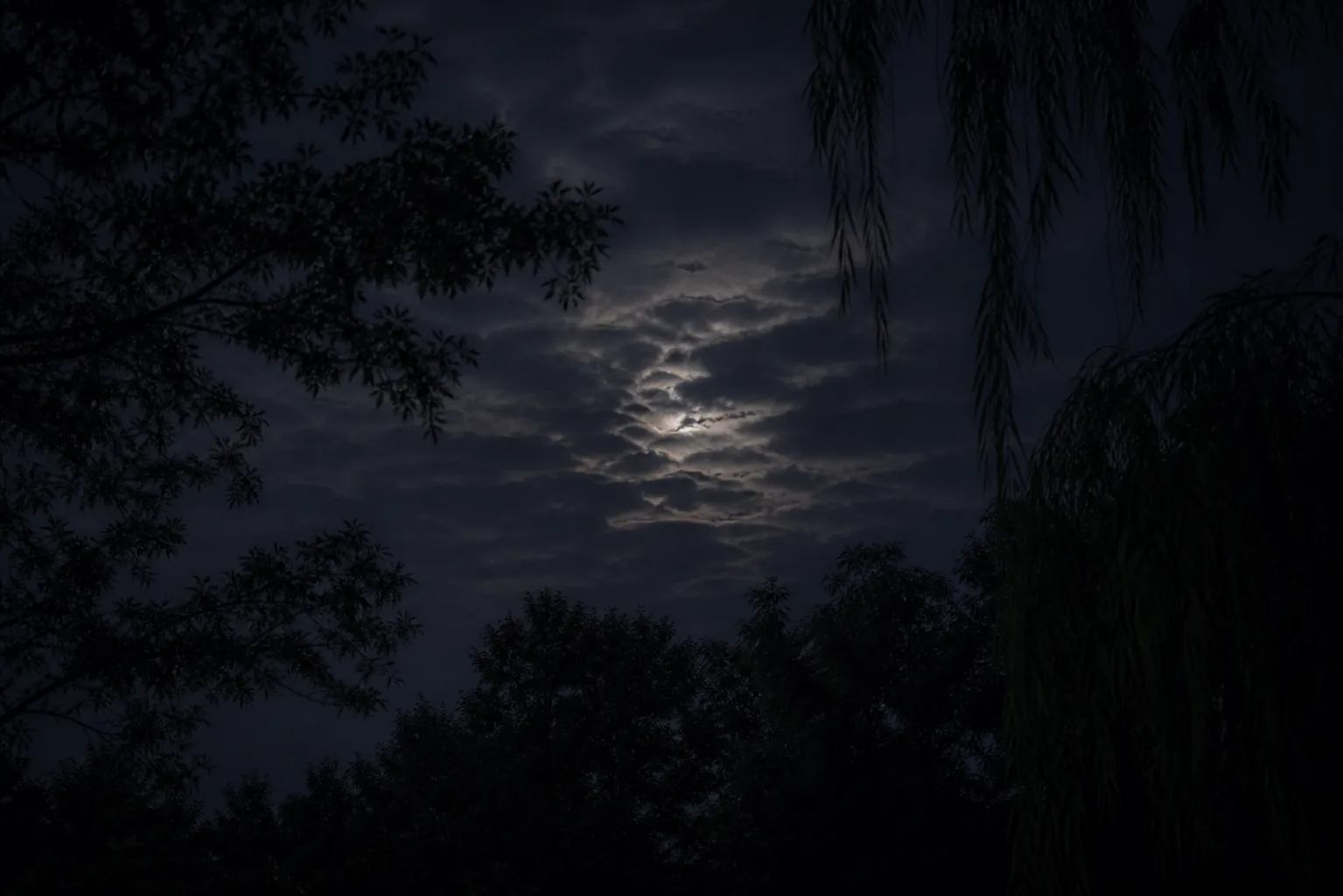
Figure 1 | Moonlight is filtered first by clouds and foliage. The film preserves the prose’s failure of brilliant illumination as a brightness in which the narrator can settle himself for now, making perceptible the kind of moonlight he chooses for this moment. This is an AI-generated keyframe, not a historical photograph.
The light still falls on one pond. “Pouring” gives it a downward, spreading motion. “Floating” lends the mist a slight buoyancy. “Veiling” lets shadows and light surround one another. “Washed” gives leaves and blossoms their clarity. These words do not lengthen an inventory; they keep adjusting sensation until an ordinary pond can hold a mind that has briefly grown quiet.
“The liveliness belongs to them”: what beauty cannot console
The essay never allows the pond to become a complete answer. At the moment when cicadas and frogs are most lively, the narrator says that their liveliness belongs to them and that he has nothing. The natural world is full of life, while he remains outside it. The solitude that just gave him freedom now reveals loneliness and vacancy as well.
The line also looks back to his earlier admission. He loves calm and liveliness, solitude and company. The pond satisfies one side of that doubleness and cannot replace the other. Beauty can redirect spiritual trouble for a time; beauty alone cannot fill every absence in a life.
The finished film keeps the cicadas and frogs audible in the mix. It does not mute nature to signal loneliness. The more alive the soundscape remains, the clearer the narrator’s distance becomes. No tears or visible despair are needed; it is enough to feel a person standing amid beauty while still separated from life’s liveliness.
Jiangnan: longing for a fuller and more intimate way of living
After “I have nothing,” he “suddenly remembers” lotus-picking in Jiangnan. These adjacent movements give Jiangnan a meaning larger than geography or allusion. Rhapsody on Lotus Picking brings young women and men, boats, songs, water plants, quiet laughter, and tacit affection into view. It is a field of life that is youthful, social, mobile, and emotionally connected—the luminous counterpart to the lonely Tsinghua pond before him.
The narrator’s longing has now acquired two layers. Solitude releases him briefly from daylight’s obligations and restores a degree of self-command. Jiangnan, in turn, calls forth a life with more vitality and emotional exchange. The first is quiet freedom; the second is warm participation. Together they answer the man who loves both calm and liveliness, both solitude and company.
“But we have long since lost the good fortune to enjoy such things,” he regrets, and the adult narrator remains outside the vision. Old writing lets him glimpse youthful pleasure, but he can no longer enter it. This essay reads the adjacent turns as one person’s desire, from within his present life, for another temperature of living; the lingering thought of Jiangnan still leaves room for memory of home, a cultural poetic world, and the historical moment.
The film carries this longing in a Jiangnan passage that is warmer, brighter, and richer in human relations, while preserving a clear entrance and exit. The classical vision becomes present enough to desire, and distant enough for the adult’s inability to partake in it to remain. If Jiangnan were merely a sequence of attractive empty views, the form of life Zhu misses would disappear.
Returning home: the walk ends, the restlessness does not
With a sudden lift of his head, the narrator is taken from his Jiangnan reverie back to his own door. The turn tells us that the walk has passed during thought and that reality has always remained nearby. His wife is asleep and the house is silent. The essay stages no conflict, reconciliation, or revelation; he simply opens the door softly and goes in.
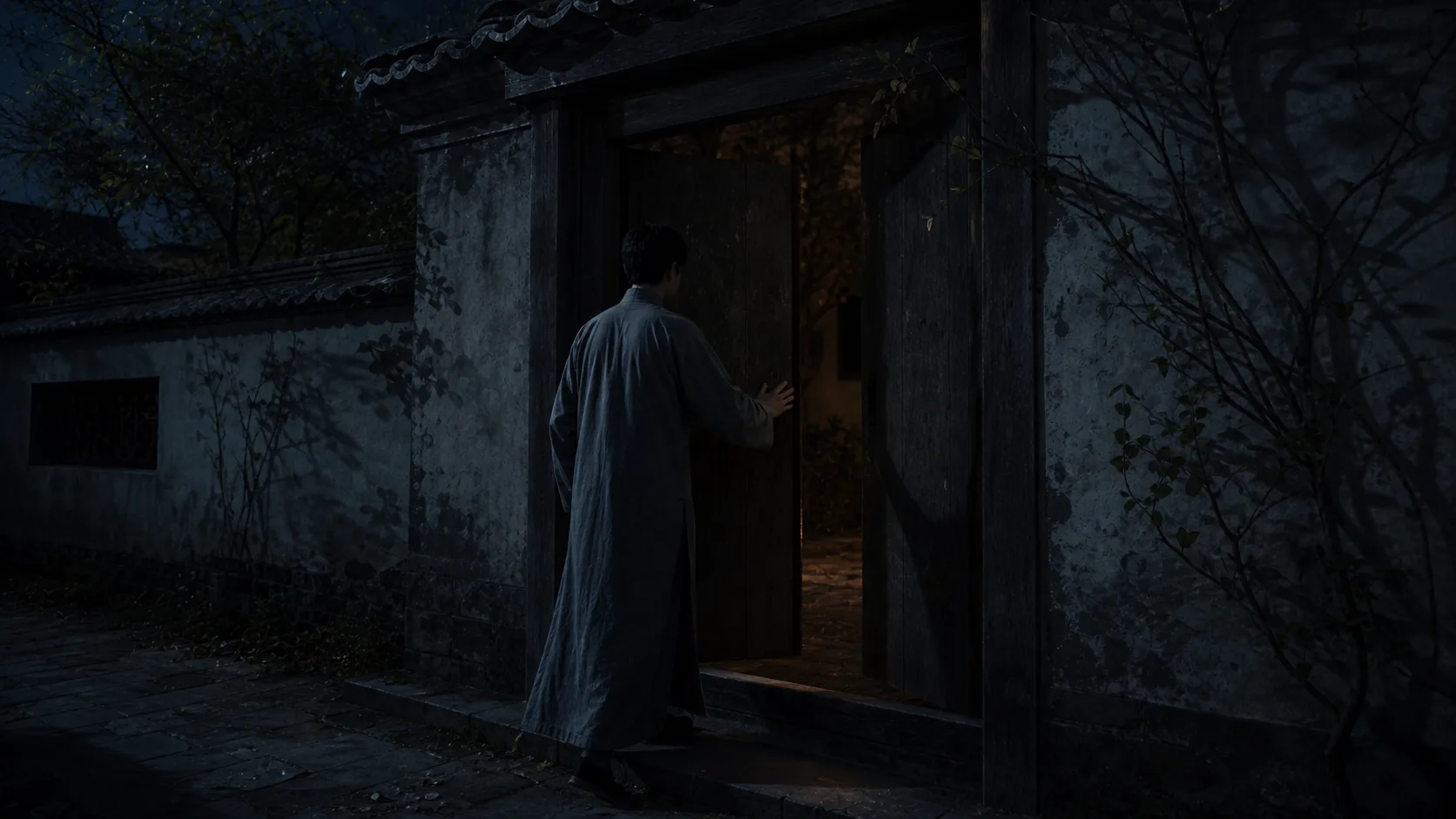
Figure 2 | The return through the gate closes the essay both structurally and emotionally. Cold moonlight outside and warmer light within reconnect borrowed freedom and the longing for Jiangnan to the ordinary life that must continue. This is an AI-generated keyframe, not a historical reconstruction.
The night walk is therefore no search for a place of permanent escape. It is closer to an inward breath an adult makes room for within daily life. The pond gives him temporary freedom; Jiangnan reveals an imagination of fuller living; the home gate reminds him that both experiences have a limit. Restlessness remains unresolved, but he returns to life carrying the moonlight of this night.
How the film makes inner movement perceptible
Film cannot photograph restlessness, freedom, or longing directly. It can only organize how viewers feel. At the beginning, the lullaby inside the home and distant sounds beyond the wall recede before the figure enters solitude. At the pond, narration, ambient sound, and silence hold separate layers, allowing attention to rest on leaves, flowers, moon, and shadow. Jiangnan then gains warmth, voices, and human relations before they fade again.
The passing-breeze passage offers a small but revealing example. As the reading reaches “a trace of trembling,” the film lets nearby leaves quiver first. Only at “in an instant” does the disturbance spread into the distance before slowly settling. That order leaves the synesthetic connection among fragrance, a faint distant song, and ripples across the leaves for viewers to feel, without turning it into a visual-effects display.
The images continue to separate physical reality, figurative perception, and memory. Moonlight flowing like water does not require another river. A faint distant song does not make a tower appear. Sixth-century lotus-picking may enter imagination but cannot masquerade as documentary action at Tsinghua in 1927. These boundaries leave room for the narrator’s mind and prevent the film from issuing a final verdict on the prose.
Result and boundaries: leaving a path back to the prose
The public film achieves three results that viewers can judge directly. The full text remains, from the initiating thought to the return home. Narration, subtitles, images, and sound occupy one 05:49 timeline. Without first reading production records, viewers can follow the narrator from ordinary pressure through borrowed freedom, sensory consolation, loneliness, longing for Jiangnan, and the return home. Lotus, moonlight, and lotus-picking all become visible while remaining subordinate to the way “I” feels about life.
It remains one interpretation. Its Tsinghua garden is constrained by the prose and historical material, but it is not an on-site reconstruction of 1927. Generated images may preserve detail errors. The pacing of voice and shots also shapes how sentences are understood. This essay reads the longing as borrowed autonomy, a fuller sense of life, and emotionally connected human company; it does not claim to exhaust the meanings of restlessness or Jiangnan. Film can help readers enter an essay again; it cannot replace reading.
The cover and page title serve as public entry points. For how they moved from a film-poster concept toward language that ordinary viewers could recognize quickly—and for the factual boundary around “zero cost”—see the cover-redesign case in the workflow essay.
The work ultimately offers a path that begins in life and returns to life. If viewers go back to the prose and see, within the beauty, a person who needs solitude, desires participation, finds temporary settlement, and still carries an absence, the film has reached a layer of Moonlight over the Lotus Pond deeper than its visible objects.
References
Textual and historical sources
- Zhu Ziqing. “Moonlight over the Lotus Pond” [essay]. 1927. Base text for the reading, subtitles, and textual checking.
- Xiao Yi. “Rhapsody on Lotus Picking” [rhapsody]. Constrains relations among boats, young people, water plants, and lotus-picking.
- Anonymous. “Song of Xizhou” [Music Bureau poem]. Constrains tall lotus plants, lotus seeds, clear water, and the poetic turn toward Jiangnan.
- Tsinghua University History Museum. “The Past and Present of ‘Moonlight over the Lotus Pond’” [web resource]. Tsinghua’s water system, Jinchun Garden, and historical layers.
- Tsinghua University History Museum. “Where Did Zhu Ziqing Walk That Night?” [web resource]. Physical clues including the west courtyard, road beyond the wall, coal-dust path, trees, willows, pond, and lamps.
- Tsinghua University History Museum. “From Celebrated Garden to Celebrated University: The Formation and Character of Tsinghua’s Early Campus Landscape” [research article]. The spatial character formed by an old garden and a 1920s campus occupying the same grounds.
- The Paper. “In Search of Zhu Ziqing’s Lotus Pond…” [web resource]. Discussion of candidate sites and spatial uncertainty.
- Tsinghua University. “Tsinghua Marks the 120th Anniversary of Zhu Ziqing’s Birth” [web resource]. Background on the author and his work at Tsinghua.
- Tsinghua Alumni Association. “Zhu Ziqing Confirms ‘Cicadas on a Moonlit Night’” [web resource]. Historical support for restrained cicada sound.
- Renjiao Yucheng. “Entering the Lotus Pond and Reading Its Implications: A Teaching Design for ‘Moonlight over the Lotus Pond’” [teaching design]. An accessible entry into the layers of reality, moonlit pond, and Jiangnan imagination.
- People’s Education Press. “Selecting and Applying Perspectives for Close Reading” [research article]. Methodological discipline for putting textual evidence first without allowing background to overwhelm the text.
- Wen Rumin. “A New Reading of Zhu Ziqing’s ‘Retreating Figure’ and ‘Moonlight over the Lotus Pond’” [article]. Provides the reading of “the beauty of solitude.” Inspired by it, this project independently chose an experience-led film rather than a classroom-style explanation.
- Zhou Xishan. “The Sense of an Era in ‘Moonlight over the Lotus Pond’” [paper]. Supporting context for 1927, not a source of literal on-screen events.
Production note
The cover and two figures in this essay come from the formal production assets for Moonlight over the Lotus Pond. This site stores only the WebP files needed for reading and their responsive derivatives. Original paths, purposes, transformations, dimensions, and SHA-256 values are recorded in the article asset manifest. The images explain the finished work; they are not historical photographs, documentary records, or the only valid literary interpretation.
Comments
Comments are public and stored in GitHub Discussions. This page connects to giscus.app and GitHub and sends the current page path only after you show comments manually or enable automatic loading. The first load is about 0.13 MB; actual usage varies with comment content. Do not include private information.