
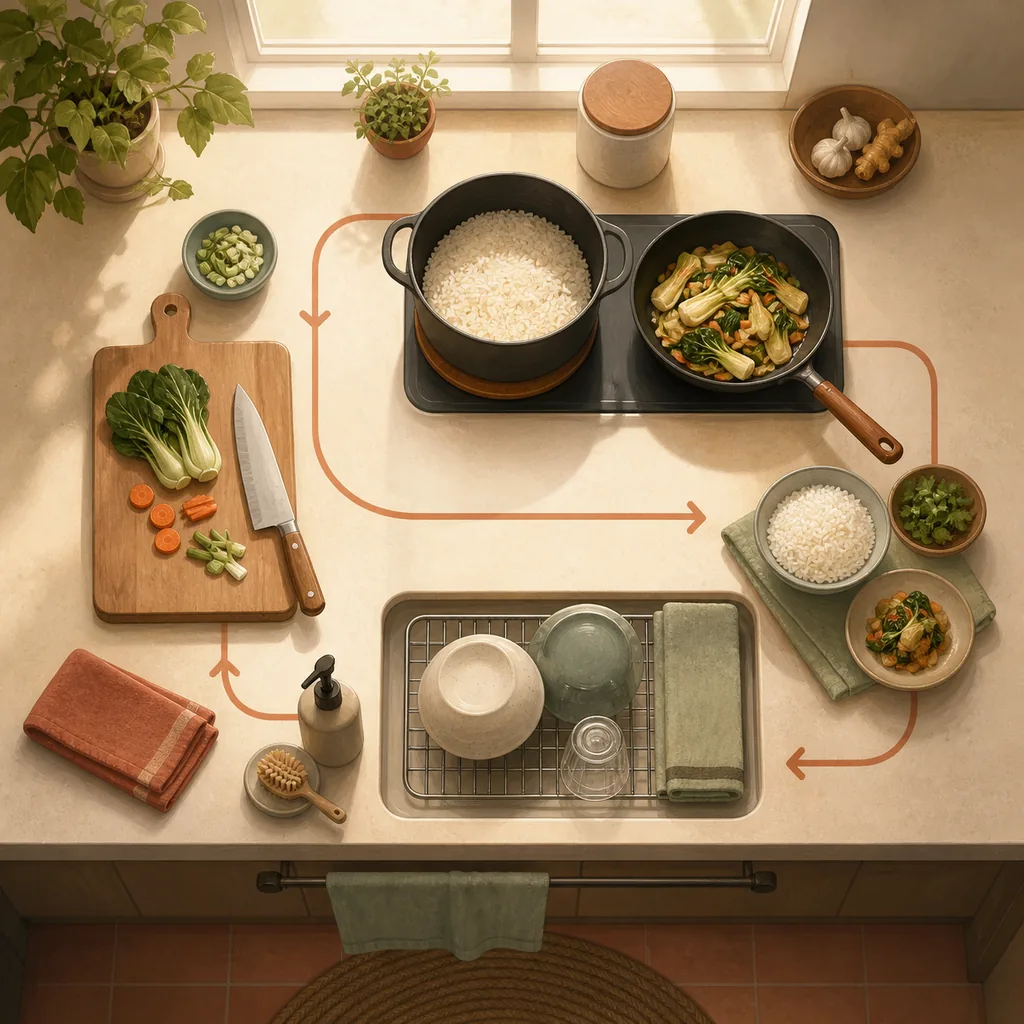
Check the list against the cooking process
When I first organized a kitchen, I kept extending categories such as knives, pans, seasonings, vegetables, and meat. The list helped with shopping, but it did not show whether I could complete a weekday meal or leave the kitchen ready for next time.
A small kitchen needs to support one repeatable cooking process:
decide what to eat → retrieve ingredients → prepare → heat → serve → store leftovers → clean up
An item deserves money, counter space, and washing time when it solves a recurring problem in this process. I therefore identify the step that keeps failing before I add a tool.
Identify five basic tasks
A small kitchen needs to complete five basic tasks:
| Task | Required result | Possible minimum tool set | When another tool may help |
|---|---|---|---|
| Cutting and preparation | Can frequent ingredients be handled safely and steadily? | One comfortable primary knife; a fixed preparation order and designated board surface based on food risk, with cleaning and sanitizing when local guidance requires it; one preparation container | Raw ingredients and ready-to-eat foods repeatedly compete for one surface, and the current process cannot reliably prevent cross-contamination |
| Moist heat | Can the kitchen boil, blanch, stew, or steam? | One lidded pot; add a steaming insert only if steaming is frequent | Capacity repeatedly limits ordinary portions |
| Dry heat | Can it sauté, sear, and reheat? | One appropriately sized frying pan or wok and a heat-safe turner | One meal repeatedly needs two genuinely different heat zones |
| Staple food | Can it reliably produce the staple eaten most often? | Existing cookware, or a rice cooker when frequency justifies it | The staple continually occupies the only burner and blocks other work |
| Cleanup | Can the next meal begin immediately? | Washing tools, a draining location, routes for scraps and waste, and a cloth that can dry | The counter stays wet or cleaning supplies have nowhere to dry |
The minimum tool set follows the three to five meals made most often and the available space. One person uses a single pot, another steams daily, and another has no open flame, so each kitchen needs its own tool set.
Test with three recurring meals
Choose three meals you will repeat: the simplest meal, an ordinary weekday meal, and a slightly more involved one. Record each retrieval, wait, temporary rearrangement, and wash.
I record four recurring problems:
- hard to find: a seasoning, lid, or tool requires a search every time;
- competing for space: the preceding step still occupies the only pan, board, or sink;
- hard to clean: a minor step creates several difficult parts to wash;
- hard to decide: ingredients are available, but no meal comes to mind.
First adjust placement, sequence, or portion size. Consider a purchase when the same problem recurs and the new object has both a permanent home and a clear cleaning method.
Answer four questions before buying
Before buying a kitchen object, I now answer four questions:
- Frequency: does it solve a problem that recurs every week?
- Substitution: can an existing tool perform the action within acceptable time and safety bounds?
- Home: where does it live, and must something else move before it can be used?
- Cleanup: who disassembles, washes, dries, and returns it, and does that work remain lower than the work it saves?
Every purchase candidate needs a permanent home and clear answers to all four questions. If one answer is missing, I postpone the purchase. In a small room, readily usable counter and storage space is often the scarcest resource.
Organize ingredients around the next meal
I organize ingredients by their role in the next meal:
- basic ingredients: staple foods, oil, and a small number of frequent seasonings that support many combinations;
- priority ingredients: vegetables, proteins, and opened ingredients that should be used soon;
- backup ingredients: frozen or shelf-stable ingredients that can form a meal when time is short;
- flavor ingredients: sauces, spices, and garnishes retained after repeated use.
The most visible space holds ingredients that should be eaten first. Before shopping, I plan the next meal from priority and basic ingredients, then buy the remaining gap. This reduces waste and limits the number of open choices.
I avoid opening several seasonings with similar uses. Before buying a new one, I plan two or three uses. If using it always requires a special recipe search, I postpone restocking it.
Sequence preparation, heating, and cleanup
Efficiency in a small kitchen comes mainly from sequence. Prepare the next step while the current one waits, and keep only as many heat sources as you can watch continuously.
A common sequence is:
- Clear the minimum usable counter and sink space first.
- Retrieve the ingredients for this meal, placing only the immediately needed ones on the counter.
- Begin with long-wait, low-contamination work.
- After heating begins, put away or wash knives, boards, and packaging that are no longer needed.
- Once food is served, deal immediately with residue likely to dry onto the pan.
- Wipe and dry the counter, then return knives, pans, and cloths to places where each can dry completely.
“Clean as you go” means using waiting time for cleanup that does not interfere with heat control. Finish with a clean workspace from which the next meal can begin directly.
Consult authoritative food-safety guidance
This method covers a personal workflow only. For refrigeration limits, internal temperatures, allergy management, and nutrition ratios, use guidance from local public-health authorities or qualified professionals that addresses the specific ingredients, equipment, and people involved.
The workflow follows several food-safety principles: prevent cross-contamination between raw ingredients and ready-to-eat foods, keep hands and contact surfaces clean, cook foods that require thorough cooking, and store food at safe temperatures. Color or side markings only identify intended use; they do not replace cleaning or sanitizing required by local guidance.
The World Health Organization’s Five Keys to Safer Food Manual is a formal entry point for these principles. Consult local guidance for a specific ingredient or high-risk person.
End each meal with cleanup
A meal is complete when the kitchen is ready for the next one:
- the main knife and cookware are clean and drying;
- the sink has room for the next preparation task;
- the counter has no residue likely to attract pests or develop odors;
- the uses and consumption priority of remaining ingredients are visible;
- cloths, sponges, and waste have reached their proper destinations;
- low-stock items are written on the next shopping list.
If cleanup repeatedly fails, I reduce the number of tools used in one meal, move waste and draining locations, or reserve a complex dish for a day with more space and time. A workable arrangement still allows cleanup when its owner is tired.
Check whether the small kitchen works
Use these seven checks for a small kitchen:
- Current tools can complete the three to five most frequent meals.
- Every frequent tool has a one-handed retrieval point and a return point.
- The shopping list records observed gaps.
- Ingredients that should be consumed first are visible when deciding what to eat.
- Preparation, heating, and cleaning do not permanently compete for one location.
- Cleanup remains manageable at the end of every meal.
- Food-safety questions return to authoritative guidance.
When these seven conditions hold, the current tools, ingredients, and cleanup process can support everyday cooking reliably.
Comments
Comments are public and stored in GitHub Discussions. This page connects to giscus.app and GitHub and sends the current page path only after you show comments manually or enable automatic loading. The first load is about 0.13 MB; actual usage varies with comment content. Do not include private information.